Essential Tech Tools for Music Production
Music Production, Tech Tools, Ableton, Sound Design, Studio Recording
Tech Tools Every Artist Needs
From your first beat to your final master, the right technology can turn ideas into release‑ready records. Here’s a focused spotlight on the essential products and services every modern artist should know, especially if you work in Ableton, love sound design, and care about professional studio recording results.

Product & Service Spotlight: Your Core Production Stack
Think of your setup as an ecosystem: a powerful DAW, inspiring instruments, smart services, and reliable hardware. In 2026, a few standouts deserve a clear spotlight if you’re serious about music production:
Ableton Live 12 - A creative hub with generative MIDI tools and the new Find Similar feature, which uses neural analysis to quickly locate matching drums or synth sounds in your library. You could learn on Ableton for years before expanding out to other plugins. Pair this with a midi controller and BOOM you can midi map any parameter!
Elektron Digitakt 2 or Tonverk - A standalone groovebox with more than 64 GB of storage is perfect if you want to sketch ideas away from the computer but still integrate with your DAW later.
💡 Pro Tip: Treat your DAW, sample service, and one hardware centrepiece as a single “instrument.” Learn them deeply instead of constantly chasing new gear.
Music Production Essentials: From Idea to Arrangement
At the heart of music production is your DAW. In 2026, options like Fender Studio Pro, Logic Pro, Bitwig, Reaper, and FL Studio are all strong, but many artists still gravitate toward Ableton Live for its fast, clip‑based workflow and performance‑ready Session View.
To turn sketches into full tracks, pair your DAW with a handful of focused tools:
A versatile synth such as Serum, Vital, DIVA or Arturia Pigments for leads, basses, and evolving pads.
Creative effects like RC‑20 Retro Color and Valhalla VintageVerb for character, depth, and space.
Solid mix tools such as FabFilter Pro‑Q 4 and Pro‑L 2 to keep your balances clean and competitive. However, Ableton Live 12 has some great stock plugins ready to go!
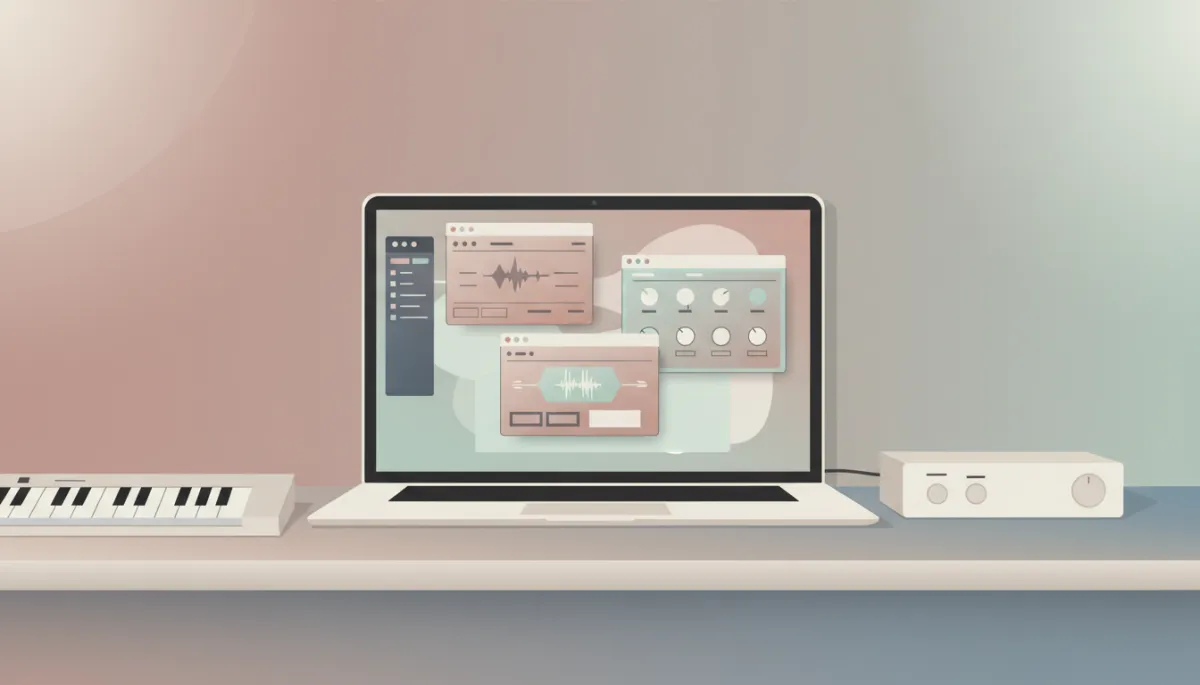
A lean set of high‑quality plugins in Ableton can cover writing, sound design, and final polish.
Why Ableton Still Leads for Creative Workflow
Ableton Live 12 doubles down on what made it a favorite: speed and experimentation. The new generative MIDI tools help you create variations on chords, rhythms, and melodies in seconds, while the scale‑aware interface keeps everything in key, even if your music theory is limited.
For Ableton users, a few plug‑ins have become near‑universal:
Xfer Serum or Vital for modern wavetable synthesis and detailed modulation. And the Wavetable or Operator also allow big shaping possibilities!
Soundtoys Effect Rack for bold delays, saturation, and pitch‑warping textures.
OTT, the free multiband compressor from Xfer, for extra punch on synths and drums. The original "Compressor" in Ableton also does a splendid job!
📌 Key Takeaway: Master Ableton’s native devices first—then add a small set of third‑party plug‑ins that genuinely expand what you can do.
Sound Design Tools for Signature Tones
To design sounds that feel personal in 2026, several tools stand out for sound design:
Ableton Live 12's simpler / sampler chained with EQs and other FX! Just pop in your field recordings and watch the magic happen!
Arturia V or FX Collection 6, including Efx Ambient and creative reverbs like Rev Ocean, turns simple sounds into lush, moving soundscapes.
TONVERK - subtracks and multi layering systems
If you want to push further into experimental territory, platforms like sonicLAB offer neural‑network‑driven instruments and AI‑assisted spatial tools—perfect for film composers, sound artists, and anyone who wants to explore beyond traditional synthesis.
Studio Recording: Capturing Clean, Mix‑Ready Audio
Even the best virtual instruments need to sit next to real‑world recordings: vocals, guitars, live drums, and more. For studio recording, a few tech choices make an outsized difference:
A reliable audio interface with clean preamps and low latency, so what you hear while tracking matches the final result. (UAD, RME, SSL)
At least one large‑diaphragm condenser microphone for vocals and acoustic instruments, plus a dynamic mic for louder sources.
A Computer with processing power that can comfortably handle a DAWs bigger sessions.
💡 Pro Tip: Before buying more, learn to work with what you have.
Bringing It All Together
The best tech tools are the ones that disappear into your creative process. A modern artist’s toolkit might center on Ableton Live 12, a few carefully chosen synths and effects, a sample service like Splice, and a straightforward studio recording chain. Around that, you can layer AI‑assisted tools, immersive audio platforms, or experimental sound‑design instruments as your needs grow.
Start with a strong core, learn it deeply, and let technology amplify your ideas, not distract from them. With the right combination of products and services, every artist today has access to a studio powerful enough to compete on a global stage.